Posts

Students and lecturers of India should be asked to review research articles
Image
Peer-review increases critical thinking, questioning, and reasoning skills among research faculties should be given in projects to earn credits, not just for publishing paper, in universities A peer-reviewer decides and introspects the authenticity of the article. Finding the error in a technical article requires rigorous effort and knowledge about the subject. Also, a peer-reviewer contribution is outstandingly important and shouldn't be ignored when compared with the author. Post-publication peer-review and pre-publication peer-review, both can be given to research faculties, so that they can earn credit for it. What projects can be given to students at elementary schools and undergraduate or higher  level? Let's talk about a project at undergraduate level: After a particular concept of a subject is taught, e.g genetics, students can be asked to review an article searching the database such as PubMed using the keyword. Let them describe a particular article in the ...

Collaborative work like questioning and answering, how its even possible in an exam oriented environment in India?

While going through the article http://www.learningscientists.org/blog/2016/7/7-1 ,  Learn How to Study Using... Elaboration, it made me think of my past education or even present schooling system in India from my siblings. It's like turning the education system upside down, just changing everything, from teacher centric to student-centric. But how it will be possible? Here the reasons that don't allow it to happen because: 1) Exam oriented environment Exam oriented environment in India, marks means everything, no matter how you secure it, through copying, through cramming, memorizing or any method you like. You are judged through your marks. Even to tackle it CCE was brought. But it has become even a greater failure because of our smart teachers who could circumvent the effort, by distributing marks for free, showing good scores to parents and everyone. The end result is negligible learning due to CCE. 2) Lack of time Leave about a lazy teacher for a while, what abou...

Books that promote critical thinking among science students at undergraduate level

Most undergraduate and post graduate books in India are not well written, promote rote memorization, state board books are just full of errors, you can't even read a page while solving problems without finding errors in the answers given. A book is not a book, if any statement you pick, does not say something useful, does not allow you to think. In the age of the internet, where data is enormous and easily available, we need a method to extract knowledge from these data.  Books allow presenting information in a form that  we can understand, grasp it as it is written in a concise and precise manner.  We need books that allow not filling the vessel but kindling the flame. Books that promote critical thinking. Here are some the books which our students and especially teachers need to follow and should be in every library: Conceptual Physics, by Paul G. Hewitt The book is very well written, the book almost relate everything in physics with real world examples. You ...

In order to understand a student understanding, ask how they are imagining things?

Image
Aphantasia , is about not able imagine the image vividly, does it trouble to create new imagination? I have always a difficulty from childhood, for recalling the image vividly, I can’t get into details of the image. In order to remember a person's face, I need to meet up with the person again at least 3 or 4 times.  Even I have trouble in navigation. But all the issues are based upon generalized context, but there are exceptions. For example, I will reach the place second time again without trouble, if I  think of/ paid attention to the landmarks, I can recognize the person with his/her face again, if I think of or paid attention to the details of his/her face while the meeting. But in common I usually can’t recall the faces vividly,  but many have a very excellent capabilities imagining person's face or knowing the direction of a place which they have visited just once. I scored http://www.bbc.com/news/health-34039054  22 out of 40 in the test of Aphantasia....

Making an effective Parents Teachers Meeting in India: Comprehensive ideas to get started

1) Parents Participation : One of the major challenges that need to be overcome is the lesser engagement of parents. Do most parents attend parents teacher meeting? What are the reasons that a parent don't appear in the meeting (in private or govt. schools)? Reasons can be many such as lack of time, uninformed about the meeting because the invitation is not done properly or ignorance towards the education of their children as in the case of govt schools. So how can we deal with it? 2) Meeting Guidelines: In order to make the meeting productive, there needs to be everyone participation. In a usual meeting, parents sit as a passive listener most of the time and  a bunch of teachers give oration about education. But, such situation should be discouraged in the meeting. The meeting is about discussing problems faced by students and even school and how it can be solved by the involvement of parents. So, before we convene a meeting even, a lot of work has to be done about specifics ...

How can central open schools such as NIOS can make a revolutionary step in the field of Personalized Education?

Most schools are overloaded with students. Usually, a single classroom in popular schools in your locality must be having more than 30 students in a particular class. To give students a personalized experience, it’s all most impossible for these schools. So, students rely on personal tuitions to meet the requirement of the students. All most all parents that have a good income, provide personal tuitions to their children. So, what role NIOS has to play? NIOS can promote mini-schools with 10-20 students in class with laboratory facilities and required teachers. They don't need to have all the classes for Std 1 to 12th. Any particular class for a startup would do, based on teacher availability. But for it, a lot of processes has to be done by NIOS. 1) Designing Curriculum  Design the best curriculum from Class I to Class 12 with book recommendation, training teachers for best practices of teaching that works (with giving complete research and statistical data of its working) ...

How practicals are done in India? How should it be done through inquiry-based approach?

Image
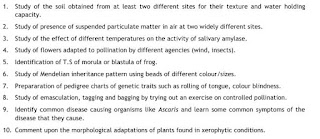
Practicals in school and colleges are all about writing records. They spend most of the time on writing records, drawing fancy diagrams without even knowing anything about what they are writing/drawing. Teachers also award students whose records are only visually appealing, not on the content/or not whether students have understood what they are doing. e.g. recently I heard from a student that teacher managed to throw the notebook because she was writing in a rough notebook. So, classes are all about writing records that teacher dictates with giving a very little practical knowledge I even don't blame the teacher. He/she does the same thing what she/he has been taught in her/his times of college. So it just a repetition/ritual way of doing things what has been done since the inception of colleges. So, how it should be fixed through inquiry-based approach? It can be fixed by bringing a change in curriculum. Let's look at the syllabus of practical. Just one or two lines...